Showing posts with label Now Playing. Show all posts

Thursday, November 3, 2016

Puzzles: Moral Quandary Test


Today I'd like to share a fun role playing activity that is really fun to work into a campaign after the players have had some time to get to know each others' characters. This is basically a team-building activity that challenges the their observational skills as how well they have established their PC's characterization. It's comprised of a series of ethical dilemmas in which the answers are not always so cut and dry.

I often frame this challenge in conjunction with a magical device or item that is attuned to the morality of the player characters. In a campaign I ran in the Planescape setting, this was used as a means to calibrate a planar transit device, allowing the players to navigate between the various heavens and hells of the netherworld based on their moral understanding of one another.

So here's how it works. Read the question for the group. Have each player record their character's answer to question. This is the important part. They should answer the question as their character would, not like they would answer it themselves.

After going through all the questions and letting the players secretly record their actions, read the first question again. Point out the first player character and ask all the other PCs to guess what their answer to the question was. Then let that player reveal their answer. If more than half of the group guess correctly, then count one success. If not, then it is a failure. Don't let the players feel too bad about a failure, because it just provides an opportunity for dramatic revelations. The party members might not know as much about each other as they thought!

Continue this process for the rest of the questions. Keep in mind that I have included more questions than are necessary for you to do this activity, so you don't have to use them all. It can take a real long time to get through even a couple of questions with a decent sized game group. If the players score more successes than failures overall, they have won the challenge! If they fail, then some interesting and dramatic complication should befall them.

You see a fight between a policeman and a bystander
DO NOTHING
TAKE UP FOR THE BYSTANDER
HELP OUT THE COP
THREATEN BOTH

Each of these people from your community are threatened. You can only save one, the rest will be lost. What do you do?
A GREAT LEADER
YOURSELF
A RANDOM CHILD
YOUR MOTHER

While looking through a scroll in the library, you find a hidden treasure map. What do you do?
TAKE THE TREASURE
TURN IT IN TO THE LIBRARY SO THEY CAN USE THE FUNDS FOR THE COMMUNITY
FIND THE LAST ONE TO READ THE SCROLL AND RETURN THEIR LOST MAP
KILL EVERYONE ELSE WHO COULD HAVE READ THE SCROLL

You are in deep cover and asked to kill a man. What do you do?
REFUSE TO KILL, SACRIFICE YOURSELF TO HELP THE MAN ESCAPE
KILL THE MAN AND CONTINUE THE MISSION
TRY YOUR BEST TO RUN AWAY

The Barony has found some illegal contraband belonging to your son. Your spouse steps forward to take the fall and serve time for it. What do you do?
CLAIM IT IS YOURS
ADMIT IT IS YOUR SON’S
LET `YOUR SPOUSE MAKE THE CHOICE
RUN AWAY FROM THE LAW AND ATTEMPT TO START A NEW LIFE

There is a storm coming. What do you do?
LEAVE WITH YOUR FAMILY
SEND FAMILY AWAY, HELP THE COMMUNITY PREPARE
TRY TO CONVINCE YOUR FAMILY TO STAY AND HELP

You are in a ticking time bomb scenario. The bomber is a fanatic and would only confess if you resort to tortuous methods. What do you do?
DO IT
KEEP GRASPING FOR OTHER OPTIONS
KILL THEM IF THE BOMB GOES OFF

Tuesday, October 25, 2016

Now Playing: Mythic GM Emulator


For those game sessions where you don't have anything prepared, or don't have any volunteers for running the game, you might find need of something like the Mythic GM Emulator.

I've tried it out a couple of times, and it is included in my binder full of random tables for improvisational game mastery. At its core, Mythic is a decision-making system that takes over the job of adjudicating your tabletop game. Think of it like a more advanced version of the old magic eight ball toy, answering any yes or no question you might pose. It also provides ways to generate keywords that can inspire an infinite number of random encounters. 

Finally, it structures the game in a way that makes the master-less adventure flow smoothly. By breaking your game into a scene to scene structure and assigning each scene a "Chaos Level," the system allows you to play out a series of engagements that tend to escalate in difficulty. Chaos levels increase the likelihood that your questions will be met with answers of 'yes.' Since those are typically questions like "Is there a booby trap in this room?" or "Is the duke angry with us?" you can see how things can get very interesting very quickly.

Overall, it is a fun and unique tool that I would recommend to any game master for their own toolbox. It can be used in conjunction with any system (Though it works best with simple systems that are less combat-oriented), and could also be used as a tool to help aid a game master with decision-making and inspiration in general. Check it out now on DrivethruRPG.

Happy ventures!

Thursday, October 13, 2016

Keeping It Eclectic: Running Multiple Games

Today I'd like to share the general outline of how I organize different kinds of tabletop RPGS for my home group. You may notice that I try to use advice and examples in my articles that can be applied to a wide range of games and genres. That's because I like to play in a variety of systems and settings whenever I can.

Since I take an approach to storytelling that sometimes emulates serialized television programs, it's only natural that I use that as an outline for how I coordinate various tabletop campaigns. I tend to divide my games into "seasons," consisting of a few sessions each. This way the players have time to get invested in a particular campaign, making some serious progress with the storyline and their characters.

Then I will break things up with what I call a "One Shot Season," in which we play through a series of episodic mini-adventures using a variety of systems. So after a season of Dungeons and Dragons we might play a season of single or two-session one shots like Deadlands, Mutants and Masterminds, or Spirit of the Century.

I'll let the play group vote on what games we play, offering a wide range of choices from month to month. Then we will return to our major on-going campaigns for another season of adventure!

Running games this way allows me to keep things eclectic and diverse, and gives the players the variety and tactical stimulation that makes for a successful gaming group. Hopefully this gives you some ideas on how to handle things if you think your own group could benefit from such variety.

Happy ventures!

Tuesday, October 11, 2016

Now Playing: '90s Superhero Name Generator

Anybody remember comics of the '90s? The bulging biceps, overpowered weaponry, grim anti-heroes and pouches galore? One of my previous one-shots was a tribute/send-up of those bizarre and gaudy adventures. To this end, I created the '90's superhero name generator. Now I'd like to share it with you. Create your own savage warrior straight from the fever dreams of Rob Liefeld himself! Characters with over-the-top names like Steel Soul or Kill Claw! Excelsior!

ROLL 1D10 ONCE ON EACH TABLE AND COMBINE THE RESULTS TO GENERATE YOUR '90S SUPERHERO NAME:
  1. Blood
  2. Death
  3. Kill
  4. Dread
  5. Iron
  6. Steel
  7. Diamond
  8. Grim
  9. Dark
  10. Tek

  1. Spike
  2. Fist
  3. Blade
  4. Stone
  5. Claw
  6. Dragon
  7. Tiger
  8. Flame
  9. Soul
  10. Star

Thursday, September 22, 2016

Now Playing: Fantasy Adventure Playlists for Specific Moods


Today I'd like to share some links to various Spotify playlists I have created to fit certain moods and atmospheres in the games I run. Each one is curated with song choices to emphasize particular themes and feelings. Hopefully some of these could be useful to other up and coming game runners. Feel free to use the playlists for a game or just as inspiration to compile your own! (A free or premium Spotify account is required to view the links.)

Standard Fight Music

Intense Fight Music

Triumphant Music

Majestic Music

Dramatic Music (Sad/Scary)

Travelling Music (Background Ambience)

Happy ventures!

Thursday, August 18, 2016

My Favorite Universal RPG Systems

For the longest time, GURPS was the gold standard for a universal tabletop role playing system. A flexible and detailed system that would allow you to run any game, from scif fi and fantasy, to noir or Lovecraftian horror. But that system has a lot of moving parts and trappings that can be overwhelming or tedious to many players, myself included. Nowadays, the rise of more modern RPG systems have widened our range of options when it comes to a universal RPG.

In recent years, a number of game systems have risen to prominence based on the selling points of simplicity and infinite adaptability. Today I'd like to share my personal favorites for running a game in any setting that you can just pick up and play. 

When it comes to a universal game system, I never limit myself to a single option. This is because there are a number of gameplay styles that fit a wide range of personal taste. Sometimes players want to tell a story, other times they desire the challenge of a game of strategy. It's good to consider which ruleset best represents the play style of your group before choosing one.

As a side note, I also really like Mutants and Masterminds and anything that uses the Apocalypse Engine, like Dungeon World. But these games still have to be tweaked and customized quite a bit before they are ready to be adapted to a unique setting. My top picks for this entry are games that can work with any genre or setting right out of the box.

Also, my least favorite universal system would be any other generic or open source D20 system. I love Dungeons and Dragons, but that system has a lot of intricacy and design built into the system to support the basic rules. Strip away the magic system, the equipment, the fantastical character classes, and you have a system that is just not very interesting or intuitive without it. Better to stick to more simple systems that aren't geared toward a specific genre of game. 

Like these great examples:

The Tactical Game: Savage Worlds

Built around the motto "Fast! Furious! Fun!" Savage Worlds is indeed fast-paced and easily adaptable for many different kinds of games. This one is the best option for players who want to use maps, miniatures, and tactical combat. 

The rules are fairly simple but allow for unique character creation and tactical options.  They are also perfect for grid-based mapping, and the use of playing cards for tracking initiative makes the combat uniquely dynamic. Overall, a great system for players who love the action-packed taste of combat! 

The Narrative Game: FATE

FATE Core, and its simplified quick-start counterpart FATE Accelerated are revolutionary when it comes to narrative focused games and cooperative storytelling. Providing a quick and easy framework for defining characters' strengths, weaknesses, and fodder for improvised plot developments. 

The main mechanic involves spending and earning points by exploiting aspects. Aspects are terms and descriptors that are applied to your characters as well as the scenes themselves. When you use these aspects to your advantage, it costs you a Fate Point. When your aspects cause problems for your character, you earn Fate Points. The special six sided dice used for this game provide a very simple and easy to understand range of numbers that reduces time spent number crunching. If your group enjoys storytelling over everything, this is the way to go. (FATE Accelerated tops my list of easiest pick up and play games.)

The Casual Game: RISUS

For those that honestly don't have time to read a whole rulebook and need to get started playing right away, there is this fun little comedic game system named RISUS. It's only a couple of pages total and you will know everything you need to play. The ultimate "Beer and Pretzels" system, a casual game that takes very little effort to get up and running. 

Of course there are a number of other RPG systems that might fit the needs of the game you want to run, but these are my particular favorites. Keep them in mind next time you have an idea for a session and need a set of rules that will fit the game. Keep in mind what kind of game you and the players want it to be, and pick the most appropriate tools for the job.

Happy ventures!

Tuesday, June 21, 2016

Now Playing: Star Wars RPG Campaigns


The Star Wars universe is a setting rich with creatures, characters, and adventures to experience on the tabletop. It is a setting with some of the most numerous materials and established histories in fiction. I have been running a Star Wars campaign recently and it has caused me to start thinking hard about how to approach the setting, adding personal touches while staying true to the lore and themes of the series.

What follows are my most relevant tips for running a fun and memorable game set in the Star Wars universe.

Use what's out there.

Recently there has been much debate over what is still considered 'canon.' Disney has chosen to ignore most of the previously established continuity in favor of their own creations. This however, has no bearing on what you do in your own tabletop campaign.You aren't limited or constrained by the standards of mainstream continuity. The entire vast library of Star Wars related fiction and merchandise is yours to mine for ideas. You can pick and choose the best material from the old and new expanded universes to create your ideal setting. Whether it is an old module from West End Games, a recent Marvel comic book, or an apocryphal video game by Lucasarts, there is a lot to pull from if you need inspiration.


Part of the appeal of using an established franchise as the setting for your campaign is that some of your players will already have a baseline familiarity with the universe. It can be a lot of fun when your players recognize a familiar ship or alien species. On the other hand, you don't want to alienate players who are brand new to the setting. Mix your original ideas and creations together with elements from the movies and expanded universe so they blend together seamlessly. Encourage players who are seasoned fans of the series to share and explain things they might recognize from the established canon. Let the continuity be shared between all the players rather than becoming an inside joke between those more versed in the lore.

Make the galaxy your own.


The Star Wars galaxy is a place of fiction that is constantly being expanded upon by a great number of writers and storytellers. This is your opportunity to count yourself among that number. You are free to design your own species, planets, technologies, whatever you might need to tell a good story. One of the more useful aspects of the setting is the fact that it is vast. There are new creatures and planets appearing all the time. So if you want to introduce a new and unique addition to the galaxy, there is nothing stopping you. As long as it fits within the continuity you have established and doesn't contradict anything else in your setting it's all fair game!


The only constraint I suggest imposing is to treat the movies themselves as the one incontrovertible source of lore and information. Most people who play the game will be familiar with at least the movies, so it's best not to stray to far from that source material. Don't go changing Chewbacca's homeworld or the way the Jedi mind trick works unless you're looking for a whole mess of trouble.


Create your own story, but stick to the proper tone.

There are a lot of different styles and genres mixing together to create the Star Wars that we know and love. It's part science fiction, part fantasy, part western... but this intermingling of themes and ideas is what gives it such an iconic style. The parts make up the whole, and distinguish it from other sci-fi series like Star Trek or Firefly.

Your first task is to identify which aspects of the Star Wars setting you want to explore in the most detail. Between exploring new worlds, fighting the Galactic Empire, protecting mystical artifacts of The Force, there is a lot of ground to cover here. The term "Star Wars" isn't quite specific enough to define what kind of game you are going to run, because there are so many kinds of stories to be told in that universe. Fantasy Flight Games makes this distinction a bit easier by dividing their RPG material into three separate games:

Edge of the Empire is all about renegades roving across the fringe of civilization. (I call it Pirates of the Caribbean in Space)

Age of Rebellion is a traditional good guys vs. bad guys war campaign.

Force and Destiny is all about space magic and Arthurian fantasy in the cosmos.

These are all cross compatible. You can combine aspects from each of these games and genres in order to create your ideal campaign, but don't overdo it. Choose which of these themes to focus on the most. This is done to avoid a cluttered, confusing game.

The best way to make this decision is with the cooperation of your gaming group. Find out from your players what kind of campaign they would like to be in. Learn what parts of the Star Wars setting appeal to them the most. Then you can decide what kind of exploits are best for your adventuring party to delve into.

The movie Guardians of the Galaxy is a very good example of what a Star Wars campaign might be like. Specifically, it would fit into the Edge of the Empire category... a band of colorful creatures set off on an adventure across the wild and criminal reaches of the cosmos. They each have their own unique abilities and motives for adventuring, but they run across shared adventures and threats at every turn.


Don't make it about the movies.

There's going to be the temptation to cross over with parts of the movies or explore some of the storylines like the Death Star or so forth. Besides the occasional cameo by a canon character, I recommend against this. In series like Star Wars, the main characters of the cinematic universe will easily overshadow your players' characters. Characters like Luke Skywalker are so significant in the grand scope of the galaxy's history that they make the team's adventures seem less impressive by comparison.


Star Wars is a setting to be used to tell an infinite number of tales and adventures. These adventures can have high stakes for your heroes as well as the future of the galaxy. But don't leave your players trying to follow the footsteps of cinematic heroes. Let them carve out their own legacy, and let the campaign be more about exploring the setting than simply trying to relive the original series.

May The Force be with you!

Thursday, March 3, 2016

Link: West End Games' Star Wars Style Guide

Today I would like to share something really neat and helpful for running Star Wars RPGs. The following link collects excerpts from West End Games' style guide for writers of their Star Wars gaming material. Included here is a lot of very sound advice for storytelling and adventure building in the SW universe to maintain its iconic themes and tone of the setting. For those interested in the setting, it serves as a very straight-to-the-point guidebook, advising the game builders to avoid cliches based entirely on the movies and explaining how to treat the galaxy as a vast expanse filled with unlimited potential.

Enjoy these little behind the scenes tidbits, thanks to Pablo Hidalgo of the Lucasfilm Story Group, and may they serve you well in your next foray into a galaxy far, far away.

Happy ventures!


Tuesday, February 23, 2016

Themes of Paranormal American RPGs

Still from the adventure game Life is Strange
A quiet little community rests in the shade of the pines somewhere in the American Midwest. The wind softly rustles the branches. In the distance, you hear a soft growl. Is it just the sound of the woodland creatures on their nightly hunt? Or is it something else? Why do the townsfolk change the subject whenever you ask? What is that blue light that seems to peek through your curtains just as you drift off to sleep? And why do you keep get the odd sensation that your television is watching YOU instead of the other way around?

This is the kind of introduction you might use if you are going to run a game from the genre that a friend* and I have dubbed Paranormal Americana.  This delightfully weird genre borders on the edge of Lovecraftian horror and science fiction. 

The most notorious examples of the genre are the television program Twin Peaks and the works of Stephen King... and if you are familiar with either of those, you probably have a good idea of what I'm talking about now. 

Other examples in this category include:

  • The X-Files (Another staple and trend-setter of the genre)
  • Gravity Falls
  • Wayward Pines
  • Alan Wake  
  • Life is Strange
  • Deadly Premonition
  • The Twilight Zone (Certain episodes, at least)
  • Welcome to Night Vale

Night Vale is the setting I usually run these kinds games in, because of the healthy dose of morbid humor and off-beat satire.
But what is this genre really about, and what makes it worth our time? Well, there are a number of common threads that draw people to these stories. The theme of weirdness lurking behind the mundane is always a major theme. More specifically, the genre explores the idea of a sinister purpose lurking behind the facade of the American community. Whether it is a suburban neighborhood or a sleepy little mountain town, the idea that close-knit communities are cult-like conspiracies serving as fronts for something insidious and dangerous. The H.P. Lovecraft story The Shadow Over Innsmouth was sort of a proto-example of this kind of tale, in which an entire fishing village is undergoing strange mutations into something inhuman.

A lot of these stories also draw inspiration from American folklore and urban legends. This covers a wide range of weird but unique phenomenons. Yetis, UFOs, ghosts, anything  that has ever been speculated by conspiracy theorists or cryptozoologists would be a good fit here. A sense of paranoia should be cultivated in these kinds of settings, and classic internet "creepypastas" like Slender Man make for good creative fodder for designing monsters and encounters. 
There are many options for interesting stories and challenges that this kind of game world can offer. For example: in the novel American Gods, Neil Gaiman explored a world where the traditions and superstitions of old world cultures had brought their magic to the new world along with them. The gods of days past then compete with the gods of the new world, gods of media and technology. This is what the setting is all about. Creating a new mythology that is distinctly modern and distinctly American. It's the amalgamation of cultures and traditions with the fears and anxieties of the modern age.

Just remember that when you run these games, don't use combat-heavy systems. These games are more ideally suited for Call of Cthulhu or some version of FATE. They are more about exploration and mystery than battling through obstacles. I think this means that they take a lot of time to think about and prepare, so I don't recommend doing them as long term campaigns. They are better as episodic scenarios, like a really good one-shot session. When I ran a Night Vale game in FATE, I had the players each as a person with a unique occupation and supernatural power. I also gave them very few stress boxes, so that the monsters they encountered would do a lot of damage and be very threatening. For horror games in general, that's the way to go. Low hit points and the potential for lasting and debilitating injury. 

So now you have a fairly clear idea how to start exploring this genre, and maybe some inspiration for a game. It never hurts to introduce some variety to your gaming group,and if your group enjoys the weird and creepy, Paranormal Americana may be just the ticket. 

Happy Ventures!


* I first discussed this terminology with Ryan Teague, proprietor of the Scan Visor podcast, which turns a critical eye to various forms of nerdy media. You can check it out at http://scanvisor.podbean.com.

Tuesday, October 6, 2015

Ten Movies That Resemble Tabletop Games!


You may have heard that Dungeons and Dragons is getting another movie treatment in the near future. There have been a number of critically unsuccessful attempts to bring the franchise to the silver screen, but this may well be the one that makes it. One big reason that it is difficult to translate the game into a cinematic experience is that there is no particular story to any pen and paper game beyond the one created by the players. Instead, a movie aimed at paying tribute to the genre should focus on recreating the dynamic of gameplay and player interaction in a fun narrative way. With this in mind, I would like to introduce my own list of movies that capture the "feel" of tabletop gaming. 

Firstly, let me break down the elements that I think are most iconic in role playing games. These are the creative choices that make a movie strongly resemble, say, a Dungeons and Dragons campaign. A movie doesn't have to include all of these elements to make the list, but these are the most commonly recognizable tropes.
  • Starring an ensemble cast of characters, each with unique talents and specialization. 
  • Delivering a sense of fantasy and wonder in a world that is unique and open to exploration. 
  • The characters develop over time, and their personalities and skills grow over this period. 
  • There is playful banter and a sense of camaraderie among the group, and they overcome challenges as a team. 
  • The characters face a wide array of obstacles that test their abilities in combat, intrigue, and guile. The characters typically follow a clearly defined mission and their adventure is based around this direct goal. 
  • The movie has a strong blend of comedy and action. 
  • The movie ends with a sense of achievement and promise of future adventure.
"Let's get this adventuring party started"
With that being said, here is a list of my first top ten movies that are like tabletop RPGs:

1. Monty Python and the Holy Grail
A classic, oft reference icon of early nerd cinema. This very funny parody of Arthurian legend is one that infamously gets less entertaining as it is quoted by snarky players at the game table for the thousandth time. Still, the comedic quest with the knights of the round table, battling monsters and foes along the way, is a great example of a movie that reminds you of goofier moments playing games of Dungeons and Dragons.

2. The Lord of the Rings series
A classic Dungeons and Dragons inspiration, as we would not have the game of D&D today if not for author JRR Tolkien. The Fellowship travels through a number of epic encounters, splits the party, and completes an incredible quest. With their line up of rangers, halfling thieves, and even a wizard, the heroes from this movie could be considered the first  D&D adventuring party. In fact, one clever internet person has already depicted this in web-comic form and the results are hilarious!

3. The Princess Bride
Another supremely quotable movie that eventually ends up following a pair of swashbucklers, a giant, and a princess in a quest to defeat an evil monarch. With fantastical settings, clever contests of wits and strength, and the fact that the entire story is projected from the imagination of a child, it could just as easily be re-imagined as somebody's particularly humorous game night. The frequent anachronisms serve to make the comparison even more fitting!

4. The Fast and the Furious franchise
This one might seem like an odd choice at first, but this quote, originally attributed to a SomethingAwful forum user, makes it clear why this goes on the list. *Strong language warning*
It's also explicitly a D&D campaign, as confirmed by a Justin Lin interview posted some pages ago. The order in which I saw the movies was 5, 1, 2, 3, 4, and going from 5 to 1 I was floored by how low-key everything was. But it's about escalation. Dom Toretto in Furious 6 is not the same person as Dom Toretto in TF&TF because he's leveled up from like 5 to 20-something. And there are things that are necessary to the process of leveling that far. There's the continuing growth and harmony of the adventuring party/family, and the acquisition and use of magic items/cars. Cars are not just a thing you drive fast in this series (Though it's kinda hilarious how there's the additional parallel of broadening scope of items. In TF&TF, the cars are super important but they don't really do much. They drive exclusively in straight lines, often badly, because these are just +2 Cars compared to the +5 Vorpal Holy Avenger Cars we get later) [Continued]
5. Guardians of the Galaxy
A great movie to showcase unlikely heroes who are each drastically different from one another. This one is all about the party! You have heroes who specialize in swords and melee, others who attack with firearms, some who are good at talking their way out of anything and others who are pure muscle and barely talk at all. A great example of the kind of variety and teamwork that is reminiscent of a fun campaign.

6. The Mummy movies
Monster encounters in caverns and tombs will be familiar to any RPG enthusiast, and this movie has that in spades. With its heroes dedicated to adventure and questing against evil, and the plethora of traps and lost chambers to explore, it sure feels at times like an old school dungeon delve!

7. Labyrinth
This one is all about the dungeon! Literally forced to traverse one herself on a quest to save her baby brother, Sarah recruits a number of other adventurers along the way. With riddles and puzzles and strange environments, this movie really captures the mood of a cleverly designed tabletop game level.

8. Gangster Squad
A lesser known recent film that manages to capture that same type of team dynamic found in others on this list. With car chases, gunfights, and other exciting encounters, this one follows a team of police on a mission to take down a mobster that could very well be the subject of a modern-day campaign.

9. Ocean's Eleven
The ultimate big team movie. With its huge ensemble cast of characters with unique specializations, it's great for showing how to give every player a role in adventure. Like Fast and Furious, the team grows and develops over time, and their collaborative achievements during the heists are very similar to the collaborative storytelling of tabletop gaming.

10. Jumanji
This is an obvious one of course, with its dice rolls for random encounters and the running theme of jungle dangers in a modern suburban setting. The new 'players' are even guided through the rules of the dangerous living board game by Robin Williams, the same way experienced players introduce people to their own favorite game.

Do you have any favorite movies that remind you of a tabletop RPG? Any that inspire you for your own games? Share your thoughts in the comment section! Happy ventures!

Tuesday, September 15, 2015

Adventure Force! A Campaign Setting for Mutants and Masterminds


Childhood artwork of the Adventure Force against the monstrous Moleculus

The M&M System

Mutants and Masterminds is my favorite system for running superheroic adventures. Its versatility in adding and customizing powers allows for the creation of just about any kind of character you might imagine. And the system does a good job of using trade-offs between accuracy and power to include a multitude of archetypes without upsetting the balance of gameplay. A gadgeteer can face off against a powerhouse without being completely overwhelmed, and vice versa. The fact that the system eschews hit points in favor of an increasingly difficult series of fortitude saves means that it does a fair job of replicating superhero battles, in which the characters exchange brutal strikes leading up to the knock out blow. This also means that that gadgeteer can dodge, weave, and wear down his enemy, but a solid hit from a powerhouse can still send him through a wall. Fun stuff!

The latest edition, the third of the series, has evolved greatly from its D20 roots. It no longer feels like a re-fluffed Dungeons and Dragons. It is now a highly modular system with character creation than some ways resembles a very simple computer programming language on pen and paper. The one downside being that the game mechanics are somewhat mathematically intensive and I recommend a quality GM screen in order to run it smoothly. I use a customized screen with the most useful tables and formulas available for reference and the game became much easier to run.


The Setting

M&M is an ideal system to use for a homebrew setting, as the core books are not oriented toward any particular setting. It's a blank slate to work from, and superhero settings are relatively easy to build once  you have decided on what comics you will draw inspiration from and have designed a few of the characters that live in it. What follows is a basic description of my setting, to give you an idea of how a simple homebrew looks in M&M.

Adventure Force is a campaign setting that was born as an amalgamation of two stories I devised when I was just a kid, Adventure Force and Herowatch. Both contained themes of superhumans existing in a world of futuristic technology and global intrigue. As the name suggests, it is fairly light-hearted, reminiscent of comics from the Silver Age or some of the more high spirited comics of the last ten years.

The Adventure Force is the name for the primary team of superheroes, comparable to The Avengers or the Justice League. They are brought together to share resources and better direct their abilities, like a gentlemen's club. But several of the members also report to other factions, so there is shared oversight and possibly even some dramatic tension between members. Their friendship and loyalty keeps the team together, and the shared goal of rising to action for the greater good.

Members of the Adventure Force include, but are not limited to, these characters...
  • Particle Man, a gadgeteer superhero with a high-tech suit of gear.
  • Lightning Man, an electrical mutant wielding sword and armor.
  • Panther Man, a cat-like vigilante with super-strength and agility.
  • Velocity, a CIA agent who can add or subtract kinetic energy to herself or anything she touches.
  • The Wind Man, a weather controlling variant of the wizard Merlin.
  • Guardian Angel, another tech-based character. A computer hacker turned super.
  • Lunar Man, a gravity controlling commando from another planet.
Particle Man (center) facing villains Centipede, Nanite, Plattius, and Cybernet.

They are opposed by a number of dangerous foes and villains, including:
  • Mister Richman, a wealthy crime lord
  • Dr. Plattius, a mad scientist with nanobot-injecting metal claws.
  • The Red Knight, a demon from the age of Camelot.
  • Bright Eyes, a laser-eyed criminal from another world.
  • Mortis, an ancient sorcerer who spreads clouds of decay.
  • Jaguar, the evil counterpart of Panther Man.

Several non-superhuman factions are important to the setting's global political climate. The group Genius Engineers International, or GENI (Pronounced 'genie') is a UN-backed research and development task force that also prioritizes peacekeeping and defense from interplanetary threats.

Section 42 AKA The Agency is a shadowy secret organization tasked with monitoring and deterring the dangers of aliens and superhumans, a byproduct of a fearful society.

Finally, there are a number of sinister superpowered soldiers who have leveraged their abilities into becoming specialized private military contractors. These characters can show up as recurring threats, and it provides a lot of flexibility in designing adventures. Whoever the main Big Bad Evil Guy might be, he can draw from some of these independent mercenaries to round out his own henchman task force.

Two Eras, Two Styles

When I run an Adventure Force game, I always allow players to choose between two different eras of gameplay, which serve as sub-settings of their own. The Challenger Era is set in the period of tribulation and discovery as superhumans become a major force in world events for the first time. Fear and suspicion of these new entities is a common response. Heroes and villains are often treated to equal criticism, and good guys may expect to be viewed as dangerous vigilantes. Technology and history have advanced only slightly more than the real world and the fearful nations of the world operate covert agencies, engaging in a secretive arms race of technology and super-powers.

Panther Man in action

On the other hand, the Paragon Era is set much later in the setting's history, as super-powers and fantastic technological innovations become widespread. Humanity makes contact with extraterrestrial civilizations and alternate dimensions, leading to the necessity for greater international cooperation.  The threats of this era are often more cosmic in nature, the products of a world that is become increasingly bizarre and unified.

By offering these two variants, the players are allowed a say in which themes and challenges will be prevalent in their own adventure. Each one sets a slightly different tone and suggests what kind of stories might be told. For instance, the Challenger Era might feature the Shadownauts, Adventure Force's sub-group of super-powered spies who are trying to prevent an Eastern European crime ring from stealing a nuclear weapon. The Paragon Era might see Doctor Plattius infect a GENI robotics expo with nano-machines and cause chaos with a mechanized army. Different strokes for different folks, it all depends on what your players are up for.

Superhero stories lend themselves to an episodic format, so they make good one shot games or short campaigns. You can keep a couple of plot threads going from session to session, but it is best to keep things self-contained, with beginning and end, like issues of a comic or episodes of a cartoon. The setting itself is what defines the continuity of your campaign, common thread of each adventure. I hope this brief overview of a sample setting has given you some ideas and material for your own superheroic undertakings. Happy ventures!

Thursday, August 20, 2015

RP-like Tabletop Games With No Game Masters

Once in a while, you just need a break from game mastering. What follows are the games that I break out when my previous plans fall through, or I don't have time to prep for a session, or I just think the players want something other than a traditional RPG.

Betrayal at House on the Hill

This big 'ole board game is for spooky adventures in grand Lovecraftian fashion. I like putting on an eerie soundtrack and reveling in the absurd B-movie feel of this one. Putting you in the shoes of a band of people exploring a haunted house, this game is different every time you play. The house is mapped out and built room by room as players draw and place special tiles on the table, so the floorplan is unique every time.

Eventually, the game automatically designates a player as the 'traitor' and they basically become a GM, attempting to defeat the rest of the cast with their special abilities and sometimes their own minions. The rules will also randomly select from one of fifty unique scenarios, including a zombie attack, a mad bomber, shrink rays, or mummies! This game can either run really short or really long, so you might even have time to play a second round in one night.


PROS: Atmosphere! Fun art design and flavor text make this an all around appealing game. The chaotic nature of its randomly generated maps and scenarios add to the suspense of "what-will-happen next?" The exploration elements and the traitor gimmick leads to lots of fun times, rivalries and camaraderie between players.

CONS: Game balance. The random aspect of this game can also lead to some annoyance. A lot of the scenarios can end up lopsided in favor of either the traitor or the adventurers. Not all scenarios are equal, some have more going on for them than others and of course you never know which one you're going to get. Finally, you need to play this one with players who are good at rules comprehension. The traitor in each scenario has his own secret playbook with a couple of special rules, and if they can't understand the rules themselves, thinks will go a bit topsy-turvy. The game itself is also quite pricey.

CONCLUSION: If you like spooky imagery and chaotic gameplay that is always surprising, give "Betrayal" a shot!

Forbidden Island

Forbidden Island is also a game in which the maps are built from  random configuration of tiles. This game is a cooperative one, in which the players' goal is to collect all the treasures and escape the island before it sinks. Simple but very tactical, this one is also limited to a specific number of players, (two to four) but is good for those who just want a nice challenge without any performance or story elements.

PROS: Cooperative play, so everybody gets to work together. Scaling difficulty levels so you can choose the level of challenge. Each player gets a unique special ability for added layer of tactical goodness.

CONS: Purely a game of strategy. The elements of randomness could skew the difficulty from game to game.

CONCLUSION: For those who like thinking games and challenges, and prefer cooperative gaming, The Forbidden Island will be the adventure they are looking for!

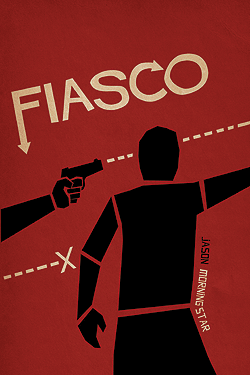
FIASCO
Fiasco is an improvisational story-telling game in which the players act out scenes to tell the tale of a frenzied, chaotic caper. The original theme is farcical Coen Brothers (Burn After Reading, Fargo) inspired antics, but there are playbooks for all sorts of genres and settings. You need a pile of six sided dice of two colors to play. The dice are used by the players to generate concepts for their characters, motivations, items, locations, and more. Then it is up to the players to act out their interactions with one another and improvise the story as if it was a movie or TV show. At the end, the players get to roll the dice one last time to determine whether their character's story ends in tragedy or triumph.

PROS: Strong focus on storytelling and simple rules. The dice are used to influence outcomes, but there are no rules for combat or interaction between players, that's all handled by the players' cooperation. There really is no winner or loser, it's more about telling a fun story. Great for people who are into writing or acting.

CONS: There's not much of a strategic element in this one. Won't really work if your players are shy or don't like to perform. It requires a very specific number of players (between three and five) to work. Some of its core material isn't family friendly.

CONCLUSION: 
With its rules-lite system and theatrical play-style, Fiasco is a great pick for a game where the game mechanics take a back seat and storytelling rules!


Time/Space Tear


This one is my own hack of FATE Core  intended for player versus player. I will share the rules for this system in a future article here. It's basically setting rules to the game kids play when they imagine what would happen if Spider-Man fought Robocop.

PROS: Translating characters to FATE allows you to include characters from any genre or setting and let them duke it out. The characters are generally balanced evenly against each other. Both physical and mental combat are permitted, so even weak but crafty characters can be included.

CONS: The system for adjudicating success is more art than science, and this game won't really tell you who will win in a fight. If your players tend to argue over rules, this isn't the game for them.

CONCLUSION: For a game that lets player combine their favorite characters and pit them against each other like tabletop Smash Brothers, T/ST is the way to go!

Do you have a favorite game system for fast fun with friends and no prep-time required? Share in the comments and keep following DMpathy for more tips and reviews. Happy ventures!

Thursday, July 30, 2015

My Own RPG Characters


My main gaming interests may be DM Theory and designing and running adventures... But when I do get a chance to play I like to be characters who are interesting and entertaining! In order to keep my characters fun and thought out, I usually limit myself to a handful of old standbys. Today I would like to share a synopsis of the characters that I play when I find myself on the other side of the screen.

They can each be adapted to any system, so I typically define them by archetype, the general style and inclination of their character. I will also include the traits that define them as well as the party members they will be most drawn to, because I think this is always important to building a cohesive group. Also, most of them are at least partly inspired by some famous performer or character, because it gives me a fun foundation to build off, and helps me quickly establish the character's look and voice. Some folks prefer playing as basically themselves in a game, and some don't like to act out their part so much, but this is my preferred way of playing. Hopefully you will find this entertaining and perhaps glean some spark of inspiration from these fellows, as I have from observing the characters I have played alongside.

1. Tracer Ero (Rogue archetype) 

Tracer is a Lawful Neutral rogue, that is he is a 'professional' thief. He takes personal pride in his work, and serves the needs of whoever is currently employing him (Usually the highest ranking party member on his team.) He is loyal but socially inept, unable to relate to the world outside of the context of his militaristic training and discipline. Inspirations for the character include Batman, Solid Snake, Snake Eyes from GI Joe, and Sosuke Sagara of Full Metal Panic! Tracer's name comes from the Calvin and Hobbes comic strip character Tracer Bullet.

2. Dave Presley (Paladin/Fighter archetype) 

Dave was inspired by Louis CK's police officer character from Parks and Recreation. Staunch and uptight, Dave is nonetheless compassionate and protective of the weak. He speaks in a stodgy but friendly manner, and tries to enforce the law as firmly and compassionately as possible. He will often view himself as bodyguard and protector to the weakest or gentlest member of the team. 

3. Zelda Wyldfyre (Rogue archetype)

Zelda is a renegade who is out to get rich and live in a palace. She is the chaotic antithesis of Tracer Ero, a street urchin turned criminal. Dynamic and free-spirited, she will relate most to whichever party member comes from the humblest origins. She is based on actress Willa Holland (I don't like to play characters of a gender opposite of my own unless their voices and mannerisms are very distinctive, and I feel like she fits the bill.) 

4. Bretek Drinks From the River (Cleric or druid archetype)

Bretek is a native from a more primitive tribe, but he has a deep understanding of the ways of man and nature. He reveres his sacred ancestor, Bazuum Climbed the Mountain, and responds to others with a simple sort of kindness. He is at times innocent to the point of naivete, as he spent much of his life in a hermetic solitude. He will find an instant connection with anyone who shares his interest in the natural world.

5. Zatara the Underappreciated (Magic user archetype)

Zatara is a mage with something to prove. Bombastic and with natural sense of flair, he speaks in a commanding theater voice. He will look to ingratiate himself with the most well-known and powerful of his comrades, and take the lesser ones under his wing.

6. Samantha "Scopes" Rambeaux (Ranger/Sniper archetype)

A tough-as-nails ranged combatant based on actress Milla Jovovich, Scopes is a veteran of many engagements, and the only PC on this list that evolved from a pre-generated character given to me by a DM. Scopes is a natural leader and team player, and will learn her team's strengths and weaknesses, caring for each of them like a bear and her cubs.

7. Theta Six (Druid/Shapeshifter archetype)

Theta Six is a quirkier character, a shapeshifter who is comprised of six separate identities. A knight, a scholar, an adventurer, a cop, a barbarian, and a monster who represents her primal id. Usually running from a dark a mysterious past, each part of her personality will favor a different teammate. 

8. Lucious Lavender (Evil archetype) 

My lone bad guy, I reserve Lucious for teams who can keep him contained. I usually don't like playing villains because I don't want them to interfere with the team or get away with heinous acts, but Lucious is Lawful Evil and will toe the line when it comes to his behavior. Sir Lavender is a pompous nobleman of a disgraced house who is willing to do anything to rebuild his reputation. He will seek out the most ambitious of his teammates with which to form an alliance. He is based loosely on Maximillian Pegasus from the animated series Yu-Gi-Oh! 

9. Orren Stoneweaver (Cleric archetype)

Orren is a dwarven cleric who talks like a distinguished American from the South. He is stalwart and loyal, and ready to jump into the fray as much as any fighter. He typically finds himself drawn to whoever is most different to himself, as he is secretly curious about life outside his own culture (Though he'd never admit it!)

10. Jumping Jack Titan (Bard archetype)

Jack is a charismatic showman based on Jack Black. He always looks for the best in his comrades, though he is not much of a warrior himself. A natural hambone and con artist, Jack will nonetheless see any good adventure through to the bitter end. He will usually stand alongside the best looking member of the group, and try to make them look even better with his bardic talents.

11. Davood Sharriff "Delta Sharp" (Sci-fi/modern/cyberpunk archetype)

For games that need a more modernistic character, I like this special agent/hacker based on actor and comedian Kumail Nanjiani. A free-running survivalist who bears fiber-optic tattoos, this guy will typically connect with anyone who is also trying to escape their past. 

12. Darmok (Cleric/Paladin/Priest Archetype)

Named after an episode of Star Trek, Darmok is an acolyte of the dragons. He reveres and respects all draconian forms. He is a mystic, prone to valor and solemnity. Slow to action, but swift in retribution. He usually takes to whoever will tolerate his windy prose and proselytizing of the draconic scripture.

13. Kote Castellan (Magic User/Swashbuckler Archetype)

A dashing hero of style and panache, Kote is a subtler mage than Zatara. An illusionist or swashbuckler who avoids confrontation, and only fights when he must. Kote will bond with whoever he thinks would make a good business partner, as he hopes to accrue a fortune for himself and his comrades.

14. Count Declan/Drogo Moffat (Leader/Planner Archetype)

Count Declan, or Count Drogo, is based off John "Hannibal" Smith of The A-Team. Cocky and crafty, he likes to think his way out of a problem. He's a cigar-chomping, hard-drinking, wily old fox with a hankering to misbehave. He will connect most strongly with trouble-makers who impress him with their sheer chutzpah.